
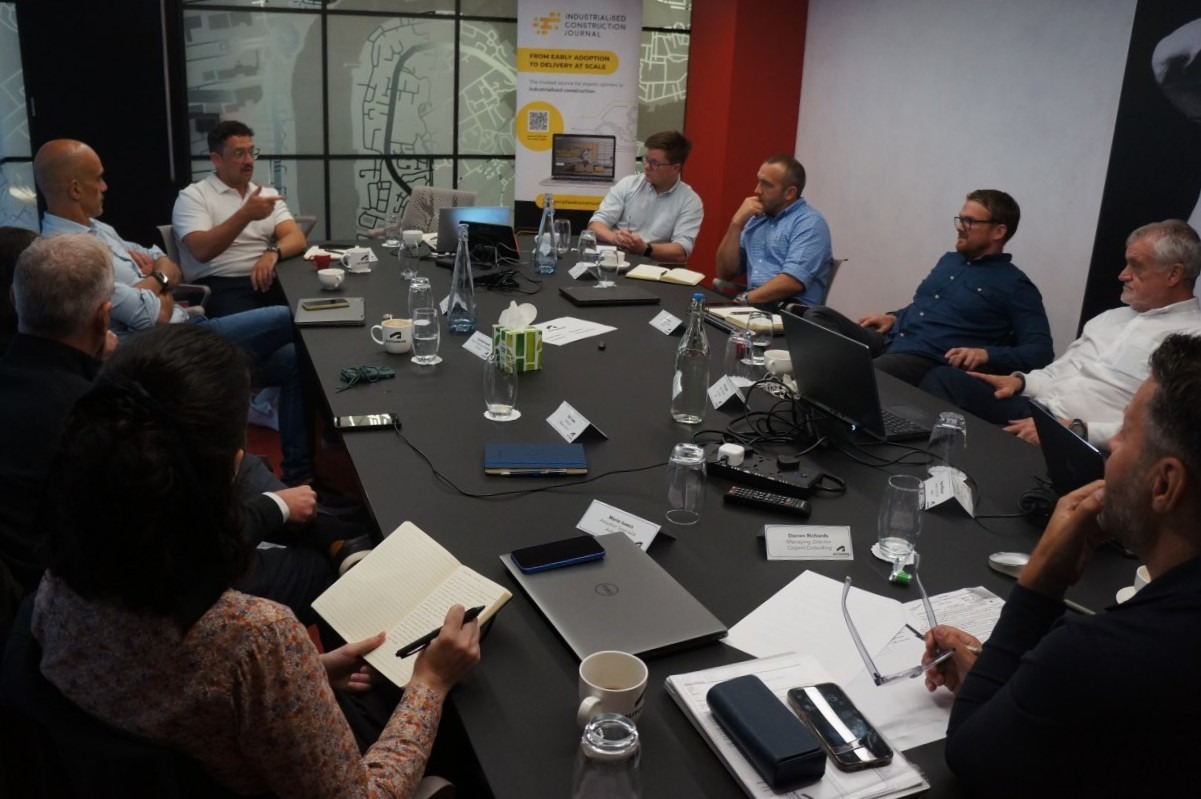
Digital construction has reached a point where better models alone will not deliver the next productivity gain. At an Autodesk-hosted ICJ roundtable, representatives from design, development, contracting, manufacturing and technology examined how data can connect early design decisions with product configuration, manufacture, logistics, assembly and operation.
Hosted by Autodesk and facilitated by Darren Richards of Cogent Consulting, the roundtable drew on Matt Warren’s client-side experience at Lendlease and contractor perspectives from Donatella Fiorella at Skanska and Tim Carey at Mace Construct. Dale Sinclair of WSP and Nicola Carniato of Tyréns AKT brought engineering and industrialised design expertise, alongside Scott Laird of Reds10 Group on integrated delivery and Paul Wilkinson of nima on information management. Product and manufacturing perspectives came from Tom Cox of Saint-Gobain and Dayle Zielentino of KOPE, while Marie Isaacs of Autodesk drew in part on her previous experience of automotive manufacturing.
That range of perspectives mattered because the discussion quickly moved beyond software. It followed the information a project needs as it moves through design, manufacture, logistics, assembly and operation. Participants repeatedly returned to the points where that information is re-entered, interpreted or arrives too late to affect a decision. Those gaps led the conversation beyond software and into product design, procurement and the commercial case for doing the same thing at scale.
 Beyond BIM
The opening question – whether BIM still sits at the centre of the digital process – exposed a useful difference in perspective around the table.
Paul Wilkinson described BIM as one part of a wider information-management process, reflecting nima’s move away from its former identity as the UK BIM Alliance and towards a whole-life view of information. That lifecycle extends well beyond design coordination, taking in operation, adaptation, reuse and eventual end of life. Matt Warren, speaking from the development side, placed more emphasis on the value of the coordinated model as a common medium through which clients, designers and suppliers can understand the same asset.
Paul Wilkinson described BIM as one part of a wider information-management process, reflecting nima’s move away from its former identity as the UK BIM Alliance and towards a whole-life view of information. That lifecycle extends well beyond design coordination, taking in operation, adaptation, reuse and eventual end of life. Matt Warren, speaking from the development side, placed more emphasis on the value of the coordinated model as a common medium through which clients, designers and suppliers can understand the same asset.
The more revealing discussion concerned what happens to the information attached to that model. Participants described project teams producing detailed asset datasets to satisfy contractual requirements, only for much of that information to reach handover without a clear operational use. Warren questioned the value of requirements that add cost during delivery without an identifiable return for the client, while others pointed to the difficulty facilities teams can face when expected to interrogate complex databases long after the project team has dispersed.
The more revealing discussion concerned what happens to the information attached to that model. Participants described project teams producing detailed asset datasets to satisfy contractual requirements, only for much of that information to reach handover without a clear operational use. Warren questioned the value of requirements that add cost during delivery without an identifiable return for the client, while others pointed to the difficulty facilities teams can face when expected to interrogate complex databases long after the project team has dispersed.
That gap between producing information and using it sits at the heart of the wider digital challenge. Industrialised delivery requires continuity, but continuity has little value if the information moving through the process is poorly structured, difficult to interrogate or disconnected from the decisions people actually need to make.
 Data, AI and the question of trust
The arrival of AI makes those weaknesses harder to ignore. The group debated whether increasingly capable systems could reduce construction’s dependence on rigid naming and classification conventions by interpreting inconsistent datasets automatically. Natural-language tools already make it easier to search and interrogate information that previously required specialist knowledge, which raises an obvious question about how much effort should continue to go into traditional data structures.
Confidence and assurance complicated that argument. A system that identifies a generic storeroom with 90% confidence may be useful; the same level of certainty applied to personal data, regulatory evidence or safety-critical engineering would be unacceptable. Dale Sinclair returned repeatedly to the need for stronger foundations around requirements, metadata and verification, particularly in sectors such as nuclear where automated interpretation must withstand a much higher level of scrutiny.
Donatella Fiorella similarly linked AI’s usefulness to standardisation and reliable source data. Scott Laird pointed to the speed at which digital tools are changing: configurators and connected APIs can now compress feasibility work that once took weeks into minutes, making long internal software-development programmes a more uncertain investment.
 Moving manufacturing decisions upstream
Dale Sinclair drew a sharp distinction between making a conventional design more efficient and designing specifically for manufacture. Prefabricated facades, MEP modules and other manufactured elements have been common for years, but a product-led approach requires earlier discipline around grids, interfaces, repeatable components and manufacturing logic. His description of DfMA as an “upstream play” captured the argument well: configuration needs to influence the building while there is still scope to change it, rather than being applied once planning, geometry and major interfaces are already fixed.
Nicola Carniato brought the discussion back to the reality that many projects remain highly specific. Complex buildings can combine repeatable manufactured systems with bespoke geometry, unusual structural conditions and specialist performance requirements, so industrialisation cannot depend on repeating an entire building unchanged. The opportunity often lies further down the hierarchy, where standard components, connections, assemblies and validated details can carry learning from one project into the next.
Tim Carey raised the related problem of one-off schemes, where there may be no second identical project over which to recover the effort invested in a product platform. That places greater importance on configurators and rules-based tools capable of improving the first design process itself, giving teams earlier visibility of what can be manufactured, how it will be installed and where constraints are likely to emerge.
Bringing product knowledge into design
Dayle Zielentino of KOPE illustrated the value of bringing product knowledge into design earlier with a study carried out alongside Saint-Gobain. Comparing standard plasterboard sizes against a live project design showed that selecting a 2.7m board instead of a 2.4m board could reduce site waste by around 40%. The analysis took around an hour, but the opportunity was identified just four days before the boards were due to be ordered.
Manufacturers already hold detailed knowledge about dimensions, tolerances, fabrication, installation and material efficiency, yet much of that intelligence still reaches designers too late. Earlier access allows those constraints to influence geometry and specification when changes remain relatively inexpensive.
The same principle applies to logistics. Carniato described projects where congestion, vehicle movements and installation constraints shaped decisions around manufacture and subdivision, with the realities of getting components into and through a site influencing the design itself. In that environment, logistics becomes part of the design process rather than a problem passed downstream for the construction team to solve.
 When the product changes, procurement follows
Earlier definition of product systems also changes the commercial conversation, with the group questioning how traditional Design and Build would work if more of an asset were configured and priced before a main contractor was appointed.
There was little suggestion that the main contractor simply disappears. Fiorella’s contribution from Skanska pointed instead towards a changing emphasis, with manufactured assemblies removing some categories of site risk while increasing the importance of coordination, sequencing and supply-chain integration. The contractor remains central, although more of its value may sit in bringing systems together and managing assembly rather than repeatedly reopening product decisions that have already been resolved.
Paul Wilkinson widened the discussion into insurance and finance, including alliance arrangements that share risk across project teams and create stronger incentives for early information exchange and manufacturer involvement. As products, data and responsibilities become more clearly defined, procurement has to respond to the same shift.
Scale, evidence and productivity
The final constraint was scale. Tom Cox of Saint-Gobain emphasised that manufacturers can test industrialised solutions on individual projects, but sustained investment in automation, new products and production capacity requires confidence that demand will continue. Without a credible pipeline, established component production remains the lower-risk commercial choice.
The contractor and client perspectives arrived at much the same place. Industrialised solutions need evidence around programme, cost, quality and risk if clients are expected to procure them repeatedly, while digital systems need to show that they are improving delivery rather than simply generating more information.
By the end of the discussion, productivity had become the most useful common measure. The value of better data, automated design, configurators and digital assurance ultimately rests on whether they allow the industry to deliver more reliably with the people, capital and manufacturing capacity available. Warren extended that argument beyond the project itself, linking industrialised construction to the opportunity for advanced manufacturing employment and a broader redistribution of technical capability across the UK.
The roundtable left a picture of digital construction that is becoming less concerned with the sophistication of individual tools and more concerned with how information supports a production system. Connecting design intent to products, manufacturing knowledge, logistics and commercial decisions is the harder task, and the one that will decide whether industrialised construction remains a series of strong individual projects or becomes a repeatable way of delivering the built environment.
To access the Autodesk ‘Spotlight on Industrialised Construction’ report, go to: www.autodesk.com/design-make/research/industrialized-construction-spotlight-report-2026
PARTICIPANTS
-
Darren Richards – Managing Director, Cogent Consulting, facilitator
-
Scott Laird – Digital and Technology Officer, Reds10 Group
-
Matt Warren – Head of Digital, Europe, Lendlease
-
Donatella Fiorella – Digital Construction Manager, Skanska
-
Tim Carey – Director, Head of Design, Mace Construct
-
Dale Sinclair – Director, Head of Digital Innovation, WSP
-
Paul Wilkinson – Senior Vice Chair, nima
-
Nicola Carniato – Studio Director, Tyréns AKT
-
Dayle Zielentino – Head of Strategic Accounts and Implementation, KOPE
-
Tom Cox – Construction Solutions Director, Saint-Gobain
-
Marie Isaacs – Customer Adoption Specialist, Autodesk
-
Vincent Bolton – Editor, Industrialised Construction Journal


