
By Oliver Novakovic, Technical & Innovation Director, Barratt Redrow
Across the UK, the residential construction sector faces a period of unprecedented challenge and opportunity. Housing demand continues to outstrip supply, the skills and labour market remains constrained, programme delivery is under pressure from cost and complexity, and regulatory expectations around carbon, quality and sustainability are intensifying. At Barratt Redrow, we believe that industrialised construction – when understood and adopted as an operating model, not just a method – offers a pathway to navigate these pressures and transform how homes are delivered at scale, reliably, and sustainably.
At its heart, industrialised construction is about shifting production logic from bespoke, site-centric builds to manufactured, repeatable systems. It requires a reimagining of the housing value chain – from “projects” that are unique one-offs, to “products” that are designed for repeatability, quality and systems thinking. This article explores the challenges that organisations like ours are confronting as we integrate industrialised approaches into residential delivery, and what broader market dynamics are shaping this evolution.
Housing Delivery Under Pressure
There are four key market pressures driving the need for change:
- Persistent Housing Shortage
The UK has a significant structural gap in housing supply. Despite political attention and policy initiatives, the fundamental challenge remains: there simply aren’t enough homes being delivered to meet demand. This impacts affordability, labour mobility and long-term economic performance.
Delivering more homes, faster and with greater certainty, requires us to rethink the fundamentals of how homes are designed, procured and constructed.
- Skills, Productivity and Labour Constraints
Traditional construction remains labour-intensive and highly susceptible to workforce shortages and productivity variability. Skills gaps at every level – from trades on site to technical coordination – add risk and contribute to programme volatility. Even with concerted efforts to expand training routes and apprenticeships, the sector’s reliance on an ageing workforce remains a structural constraint.
Industrialised approaches, driven by factory environments and mechanised production, offer a way to reduce dependency on scarce labour, while enhancing predictability and quality.
- Rising Costs and Programme Volatility
Construction costs have risen sharply in recent years, influenced by material price fluctuations, supply chain disruption and logistical complexity. These pressures are compounded by programmes that are vulnerable to weather, coordination inefficiencies and rework.
By shifting significant portions of production into controlled, factory environments, industrialised construction helps minimise waste, shorten timelines and reduce the drivers of cost overruns.
- Regulatory & Investor Focus on Carbon, Quality and ESG
The regulatory environment is evolving rapidly. The impending Future Homes Standard, net zero commitments, embodied carbon reporting and ESG expectations from institutional investors are now central to viability and reputation.
Delivering high-performance, low-carbon homes is no longer optional – and doing so through traditional site-based practices alone makes these objectives harder to achieve at scale. Industrialised approaches – with design standardisation, predictable quality control and repeatable manufacturing – align naturally with these emerging expectations.
Industrialisation as an Operating Model
For many years, industrialised construction was discussed in the industry as a series of techniques – volumetric modules here, bathroom pods there, panelised façades somewhere else. But the real point of inflection is happening now: industrialisation is being adopted as a core business strategy by forward-looking developers and manufacturers.
What does this mean in practice?
From Method to Operating Model
Industrialised construction is no longer just about choosing a build method; it’s about reconfiguring the value chain – from design through to delivery – to align with repeatable, scalable systems. This requires:
- Treating factories as strategic assets – not outsourced, transactional suppliers.
- Integrating design, procurement, and manufacturing with the frontline delivery strategy.
- Rethinking risk allocation, contractual relationships and performance incentives.
In essence, organisations are considering a shift from traditional subcontracting models, where individual trades are assembled on site, to integrated systems where product platforms are developed, manufactured and assembled, often through long-term partnerships or in-house capability.
Universal Principles that Unlock Value
Across all industrialised approaches, several principles are common:
- Design Standardisation & Early Certainty – Homes and components designed for repeatability enable manufacturing precision, reduce variations and create pathways for quality assurance early in the process.
- DfMA-Led Delivery – Designs for Manufacture and Assembly (DfMA) encourage decisions to be made early and clearly, enabling coordination and minimising costly changes downstream.
- Factory-Based Quality and Productivity – Controlled environments reduce weather impacts, improve labour conditions, and enhance quality consistency through monitored processes.
- Fabric-First, Low-Energy Performance – Systems designed with built-in energy performance align directly with the Future Homes Standard and broader decarbonisation ambitions.
- Platform-Based Housing Design – Creating families of repeatable components that can be configured for local needs, while retaining core design integrity and manufacturing efficiency.
When these principles are embedded across design, procurement, and delivery, the benefits compound: higher output, better quality, lower risk and improved sustainability.
Digital Enablement: BIM, Coordination and Design Freeze
Industrialised construction cannot succeed without digital foundations. At Barratt Redrow, we see BIM-led coordination from concept through to manufacturing as essential. Building Information Modelling (BIM) becomes the central nervous system of delivery – enabling:
- Coordination across disciplines and supply chain partners
- Accurate, shared data for manufacture and assembly
- Early design freeze that gives factories the certainty they need
- Integration of customer personalisation without on-site disruption
Digital platforms support traceability, reduce rework and enable information continuity from early design through to handover. They also empower customers to engage in personalisation options that are digitally integrated back into the manufacturing workflow – not left as site-driven afterthoughts.
Delivering Industrialised Manufacturing at Scale
Industrialised manufacturing in housing isn’t just about bricks or boards – it is complex systems production, often encompassing:
- Panelised elements with high value-add (structural and non-structural)
- Bathroom pods, MEP kits, façade assemblies
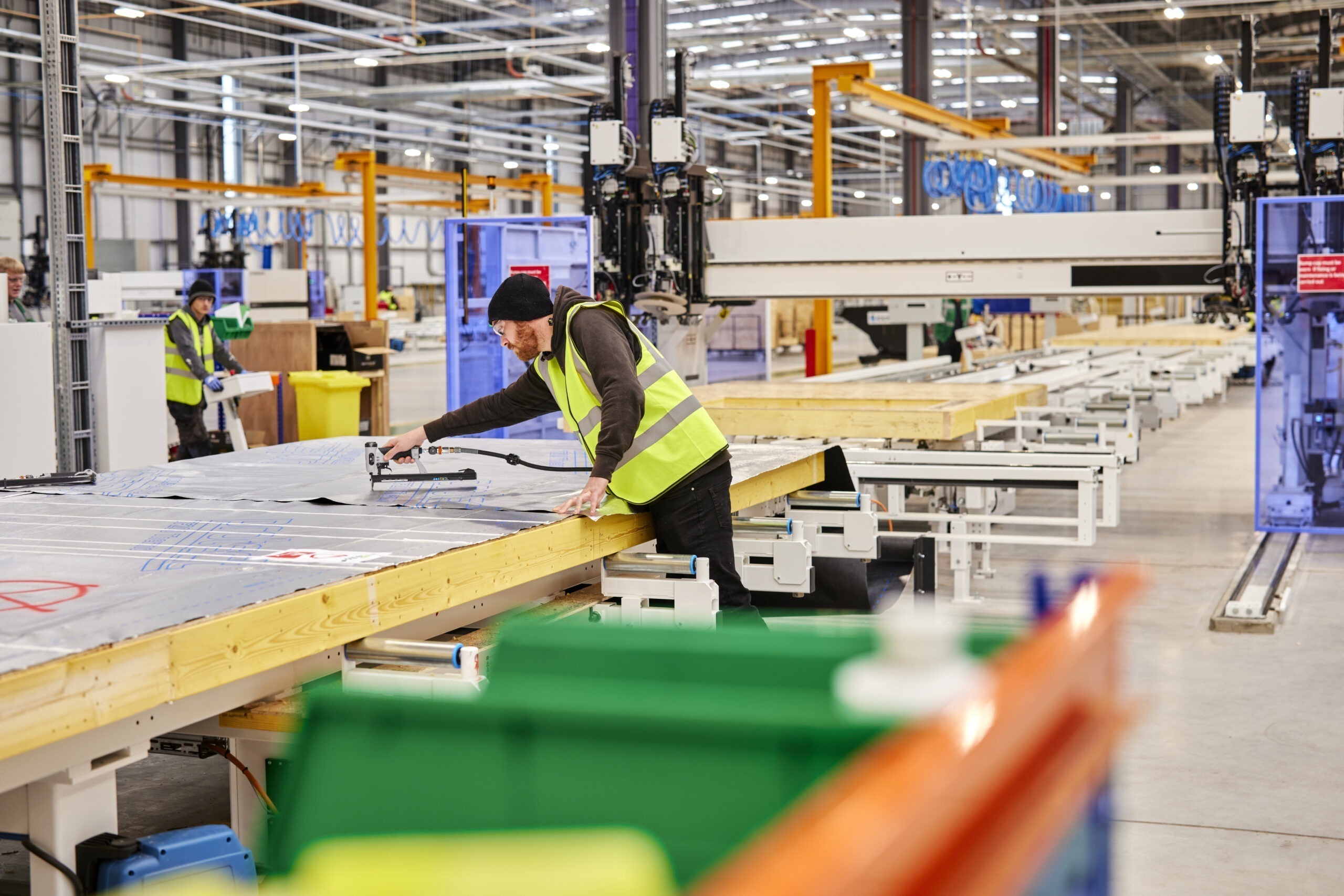
- Automation and robotics that drive predictable output, quality control and traceability
Scale means repeatability and predictability. Automated manufacturing allows a level of control that reduces dependency on skilled site labour, minimises waste and improves consistency. But delivering this at scale introduces its own challenges:
Capital Investment and Factory Capability
Turning industrialised construction from concept to reality requires significant manufacturing investment – often in automation, robotics, quality systems, and digital enablement. For developers, this means rethinking the balance sheet: investing in production capability has to be justified not only by direct returns, but by strategic value over the long term.
Supply Chain Integration
Developers must navigate how to integrate supply chains into an industrialised model rather than simply source discrete inputs. This is a strategic shift: it requires collaboration, data sharing, aligned incentives and sometimes joint investment with manufacturing partners.
Standardisation vs Local Adaptation
Standardisation is a core enabler of productivity, yet housing customers seek variation and choice. The challenge for industry is to right-size platforms – creating families of repeatable typologies that can be configured locally without compromising manufacturing efficiency.
Re-Engineering the Housing Value Chain
For organisations embracing industrialised delivery, value chain transformation is real and far-reaching:
- Moving from project-centric delivery to product thinking
- Understanding the strategic benefit of standardisation and repeatability
- Embedding sustainability through design and manufacture, rather than retrofitting it on site
- Treating digital workflows, fabrication facilities and supply chain partners as core enablers, not adjuncts
This is not a trivial shift. It changes how contracts are structured, how risk is managed, and how leadership teams think about investment, delivery and customer outcomes.
Conclusion: A Strategic Imperative for Housing Delivery
The UK’s housing challenge is too large and too urgent to be met solely through traditional construction. Industrialised construction offers a compelling alternative – not by replacing the core competencies of builders and developers, but by amplifying their impact through systems thinking, manufacturing logic and repeatable excellence.
The journey is complex and demands leadership, investment and collaboration at scale. It requires developers to think like manufacturers, and manufacturers to think like delivery partners. But the rewards – higher output, better homes, lower carbon, reduced lifecycle risk – are too significant to ignore.
At Barratt Redrow, the country’s leading homebuilder, we are committed to advancing these models thoughtfully and responsibly. The shift to industrialised production is not a question of “if”, but “when” and “how fast.” And for the housing sector as a whole, accelerating that transition is essential if we are to deliver the homes our communities need – now and for generations to come.