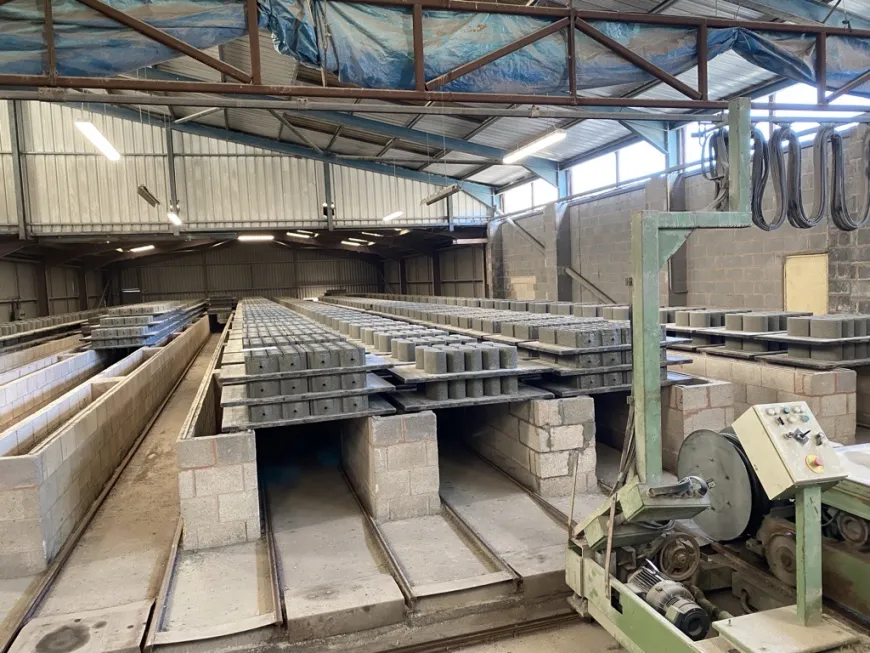
A collaborative precast concrete trial involving the Environment Agency, Material Evolution and RPC Contracts has demonstrated that embodied carbon can be reduced by 20% without increasing material costs or disrupting manufacturing processes.
The project focused on RPC Contracts’ Dycel 150 interlocking concrete blocks, which are commonly used for reservoir spillways. By increasing the proportion of pulverised fly ash (PFA) from 14% to 30% and incorporating Material Evolution’s MevoXL admixture, the partners developed a lower-carbon concrete mix. The trial was carried out through the Environment Agency’s Decarbonisation Technology Accelerator programme.
Material Evolution first modified the existing concrete mix in laboratory conditions before trial blocks were produced and tested. According to the project partners, the revised mix achieved a 20% reduction in embodied carbon while allowing RPC to maintain its established production methods and turnaround times.
Testing showed that the blocks achieved a compressive strength of 78N/mm², exceeding the reported specification requirement of 50N/mm². The Environment Agency said the revised formulation reduced carbon emissions while meeting performance requirements and avoiding additional costs.
Andy Powell, technical assurance lead at the Environment Agency, said: “Cutting carbon across all of our infrastructure projects is one of our biggest priorities as we move towards net zero.”
He added: “This simple change in formulation with RPC and Material Evolution is exactly the kind of solution we are excited about, one that delivers real benefits without compromise.”
Tony Maxwell, managing director of RPC Contracts, highlighted the ease of implementation, stating: “During this trial what stood out the most was how little we had to change with MevoXL.”
He continued: “The process stayed the same, the material costs stayed the same, but the blocks came out stronger and we saved carbon in the process.”
MevoXL has been developed to help concrete producers overcome the early-strength limitations that often restrict the use of higher volumes of supplementary cementitious materials. Commenting on the technology, Ian St Hilaire, technical and commercial director at Material Evolution, said: “MevoXL enables concrete producers to use more of the materials they’re already familiar with, while solving the early-strength challenges that usually limit high-SCM replacement mixes.”
The trial used pulverised fly ash, a supplementary cementitious material traditionally sourced from coal-fired power stations. The Environment Agency notes that concrete contributes up to 25% of its embodied carbon footprint, making the adoption of lower-carbon concrete solutions a key focus within its infrastructure programme. Trial blocks have been manufactured and tested ahead of their first site deployment, although details of the installation programme have yet to be announced.