
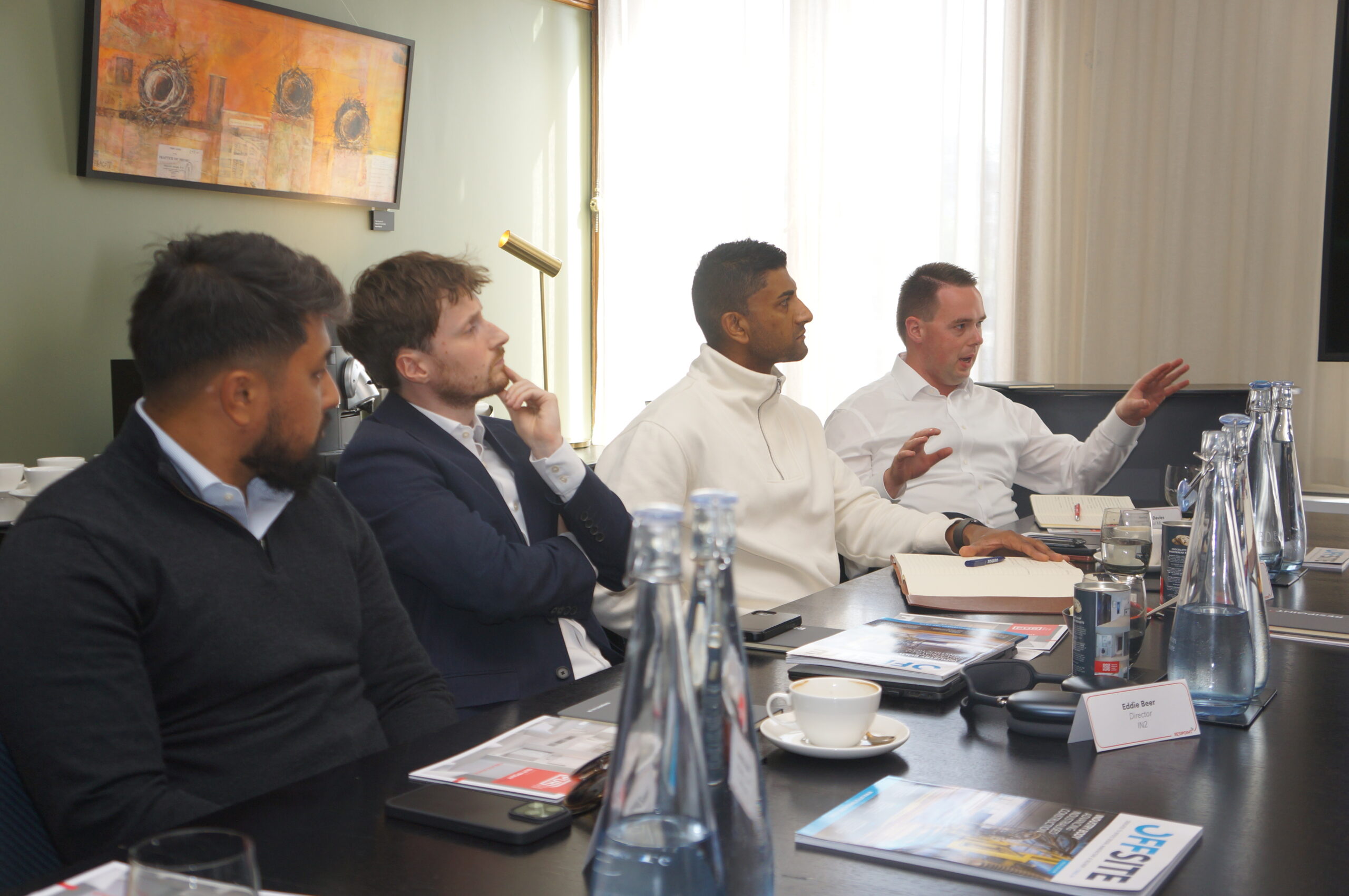
Packaged Utility Rooms (PUR) are a commonplace part of the offsite spectrum but also a slightly misunderstood and underreported one. An industry roundtable hosted by PUR specialists Resipoint, highlighted some important sector issues plus what to expect in the future.
PURs have long offered a prefabricated, fully integrated service solution for both residential and commercial buildings. These pre-assembled, factory-built units are designed to house essential building services such as plumbing, electrical systems, heating, ventilation, and even laundry or storage facilities, before transportation to the construction site for installation. This allows developers to reduce cost, give architects and building designers a creative floor space solution and for contractors – save critical time on-site, whilst improving quality control.
They have also emerged as powerful enablers of the industry’s continuing shift toward design for manufacture and assembly (DfMA) and industrialised construction methods to enhance quality, energy efficiency and ease of maintenance. The concept promises swathes of efficiency, improved productivity, better quality, and compliance in equal measure, but the reality is more nuanced.
While PURs are discussed as part of offsite innovation, developers and specifiers wrestle with core questions: do PURs deliver measurable programme benefits? Can they genuinely support the Golden Thread of information demanded by the Building Safety Act, where do the commercial tipping points lie, and crucially what stands in the way of wider adoption, with traditional in-situ installation still seen as less of a risk?

The case for early engagement
As with many construction-related problems, the solutions rest in early engagement and better planning. Offsite manufactured solutions require design decisions to be locked in earlier than traditional builds, although the BSA is rapidly changing this approach. Early collaboration between architects, M&E consultants, and manufacturers – with more Building Information Modelling (BIM) can help integrate PUR layouts at concept and master planning stage. PURs can compress construction programmes, but programme savings rely on clear ‘linear management’ and early decision-making to gain the maximum benefits. A lack of this can see a disjointed critical path, with units arriving early on-site – or even sat idle waiting for commissioning –to put undue pressure on the rest of the construction programme.
“The merit in an offsite manufactured solution is if the main contractor and developers can make a decision early and that decision can be shared with the supply chain,” said Sat Lola, Head of MEP at Mount Anvil. “Effectively – invest time upfront – at RIBA stages 3-4 – and the savings and value will come later with exponential gains in delivery at stage 5.
Standardisation – what is it?
If there is any part of the offsite spectrum where standardisation offers a prime opportunity to maximise cost and critical path benefits – it is a PUR. As pointed out many times during the discussion, PURs rarely vary in terms of the typical content and can accommodate reconfiguration to suit. They have a predetermined carcass and house ‘predictable’ components such as MVHR units, heat interface units (HIU), metering and similar components. Maintaining a consistent carcass and core layout – while swapping out components to meet specific system or client requirements – offers ‘invisible standardisation’, that from a manufacturing perspective, drives volume efficiencies.
But there is industry tension here. Developers worry about standardisation not meeting specific site or client needs, but as pointed out: “There as many opinions about what standardisation means as there are people in this room.” The ethos of higher standardisation means the more competitive the unit, with a rationalised matrix of cupboard types delivering ‘meaningful’ efficiencies and top quality.
Different permutations require understanding that diverse types of cupboards and heating issues can be different thereby creating conflicts. “Standardisation is great, but the overriding objective must be: are we satisfying the design requirements for the apartment?” said Eddie Beer, Director at IN2. “An average customer may not necessarily appreciate a well finished utility cupboard, but they will definitely notice a poorly finished one.”
The point of standardisation is to move away from introducing more work into project complexity – it is important to see where value can be added. “It makes it easier if we can rationalise and standardise the cupboard layouts,” said Wahid Sohrabi, Design Manager for Woodford. “If various types and size of manufactures can get involved earlier and present a standard RIBA stage 2 design, it becomes less problematic and easier to design co-ordinate. These important considerations must be made early on.”

The Golden Thread
The Building Safety Act (BSA) has profound implications for everyone working in the built environment. The Golden Thread – where components should demonstrate a ‘verifiable, traceable and auditable pathway’ – is central to on-going building safety management and compliance. PURs have an inherent advantage by being manufactured in a controlled factory setting. Every component, piece of product information, serial number, and test result can be digitally recorded and linked to an ‘as-built’ model.
An information pack – accessible by a simple QR code – can link to a compilation of traceable and verifiable PUR information. This will create a stronger compliance pathway than fragmented on-site installations. The BSA has focused minds on getting design done earlier and forcing more of a collaborative environment, something the construction industry constantly says it needs more of but struggles to achieve. But what it certainly does is ‘reduce complacency’.
Embodied carbon
As net zero targets loom, the ‘intangible’ benefits of PUR need to be more clearly communicated. Embodied carbon and product lifecycle analysis impacts are rising on client agendas and across ESG strategies, alongside circularity, increased social value – these are all hidden, difficult to quantify and to put a price on. Theoretically, a prefabricated option should allow all these markers to be managed better than a traditional in-situ option. PUR align well with digital product passport strategies, capturing data on product composition, recyclability, and environmental performance.
The complication in building a case for offsite here is comparisons. Ideally a lifecycle analysis (LCA) of a ‘traditional’ build as a comparator to a ‘prefabricated’ build is needed to make an estimation of what does work and doesn’t work and where best to optimise. “We need to commit to share more detail on the strategy of how things are done traditionally,” says Andy Seary, Group MEP Director at C Watkins. “We can then get a better understanding of where we can all benefit from a modular approach.”

Commercial realities
Perhaps the most persistent barrier to PUR adoption is perceived cost. Many stakeholders perceive PUR solutions as costlier than traditional on-site assembly due to upfront design, engineering, and factory production costs. This perception is overshadowing the tangible long-term benefits of offsite. The business case hinges on demonstrating ‘cost neutrality’ whether this be through programme savings, reduced snagging and maintenance and overall risk mitigation.
A key talking point surrounded the clarity of responsibility across the supply chain, particularly around defects, warranties, and aftercare.
Poor interfaces remain a ‘pain point’. Clearer lines of responsibility are required to determine accountability for defects, including how costs and warranties are allocated among M&E contractors and identifying who is responsible for addressing and resolving issues. Written agreements should be established to commission warranties through the M&E contractor. Perhaps new contracting models may need to emerge to address these complexities and improve process efficiency.
Despite strong logic and emerging case studies of successful projects – it seems that PUR adoption remains patchy. Why is this? There is still some cultural construction resistance. Adversarial DNA still fuels mistrust around cost transparency and protectionism amongst supply chain relationships. There is also supply chain fragmentation with too many stakeholders and too few collaborative frameworks. This lack of transparency stymies collaborative culture.
For sure, too many assumptions are made about what goes on within a traditionally fitted out M&E package. Prefabricated systems are painstakingly detailed, and more work needs to be done across the sector to ‘overlay’ the two process maps to understand how they compete and how best to get the most from each and figuring out where the process can be best synchronised. There is even a case for mock-up within a factory environment to create ‘real life’ scenarios reflective of the environment the PUR will be in, so M&E contractors can understand what is required – especially regarding interfaces.
“Challenges still surround the management of interfaces,” said Eddie Beer. “Standardisation and trying to get to a stage where you understand the PUR permutations for a 500-unit scheme and trying to co-ordinate the interfaces behind dropping a single cupboard into perhaps 20 different apartment types and making sure that your extracts, intakes, pipework, etc all connect at the appropriate point and with the correct tolerances can be a challenge. We recommend a fully co-ordinated model at RIBA stage 4 or 4C before manufacture.”
Plan for prefabrication
A PUR may be the first and last thing a user sees in entering and leaving their apartment, so it’s got be right. They represent one of the most practical pathways to industrialised construction and as the discussions showed, there is a lot of positivity around the general direction of travel of PUR, but their adoption and strategies to increase their usage across the construction sector is complex. Everyone agreed that PUR technology is exceptional and of the highest quality, but is there a fulling compelling argument with evidence that they do work? There is still a challenge to convince clients, developers and contractors. Adoption of PUR is certainly not stifled by technology advances. For future success, addressing misconceptions about cost and supplying hard data to substantiate the many anecdotal claims, manufacturers and contractors can truly unlock the full benefits of PUR technology.
Many thanks for everyone that gave up valuable time to attend the discussion. Find out more about PURs and Resipoint at: www.resipoint.co.uk

Takeaways
- Early engagement – confirming the offsite approach at RIBA Stage 2 ideally, enabling design co-ordination and procurement alignment. As with virtually everything construction related, the case for PUR begins with early specification
- Heat Pumps – an underdeveloped market opportunity exists for the introduction of more heat pumps into the PUR offer but with reduction in fittings – it’s not the simple ‘plug and play’ option
- Warranties – clear allocation of risk and responsibility, particularly surrounding defects
- Communication – better education of project stakeholders on programme certainty, sustainability benefits, and quality assurance and the overall ‘intangibles’ associated with PUR
- Building Safety Act – this is focusing minds on better collaboration and clearing away ‘complacency’ using the Golden Thread of information.
- Data – the need to collect and share LCA, EPD data to explain the carbon benefits and circularity/net zero aims, especially surrounding embodied carbon. Too many anecdotal claims – what is required is hard data to plug into a system/spreadsheet and provide a trusted measurable answer
- Cost Neutrality – a better and more robust way to identify cost savings and demonstrate programme benefits for offsite vs traditional in-situ methods. Valuing lifecycle outcomes over upfront price and replacing fragmented decision-making with collaborative, evidence-driven strategies. This is a PUR manufacturer imperative.
Attendees
- Facilitator: Darren Richards, Managing Director, Cogent Consulting
- Eddie Beer, Director, IN2
- James Cregan, Senior Technical Director, Mount Anvil
- Grant Davies, Sourcing & Innovation Manager, Resipoint
- Simon Lindop, Head of Cost Planning, Mount Anvil
- Sat Lola, Head of MEP, Mount Anvil
- Vernon Milner, Project Co-ordinator, Resipoint
- Laurie Pomeroy, Managing Director, Resipoint
- Andy Seary, Group MEP Director, C Watkins
- Wahid Sohrabi, Design Manager, Woodford.


