
As the UK grapples with a significant housing crisis and escalating demand for affordable homes, could the construction industry be poised for transformation through innovation? Among several emerging trends, industrialised construction may provide part of the solution, capable of enhancing efficiency, reducing costs, and addressing the urgent need for new social housing.
The need for innovation in social housing
The stark reality of the UK housing crisis cannot be overstated. With an estimated shortfall of 6.5 million homes and over 1.3 million individuals on social housing waiting lists, conventional methods of housing construction alone can no longer keep pace with the escalating demand. The impact of policies such as Right to Buy has dramatically reduced the availability of social housing, emphasising the urgent need for innovative solutions that ensure sustainable and affordable homes for all. Plus, the huge skills shortage means that there aren’t enough tradespeople to build all the homes we need using conventional bricks and mortar approaches.
Government funding has increasingly become a focal point in discussions about social housing delivery. The recent announcement of £39 billion for the Social and Affordable Homes Programme (SAHP) aims to accelerate new builds in England, with an ambitious target to deliver 300,000 new social and affordable homes over the next decade. However, funding alone will not suffice; the construction industry must embrace new methodologies to meet these ambitious housing targets. This is where industrialised construction becomes particularly relevant.
Industrialised construction: could it be a game changer?
Industrialised construction is characterised by a standardised approach and is defined by the Construction Leadership Council as: “…the application of standard, repeatable manufacturing and assembly processes to the delivery of building and infrastructure projects.”[1]
There is a similar ethos to other, perhaps more familiar approaches – MMC,[2] offsite construction, modular and Design for Manufacture and Assembly. Industrialised construction often includes some level of offsite manufacture, and it requires a design approach for components and sub-assemblies that are efficiently manufactured, transported and assembled, and easily repeated.
An industrialised approach to the design and manufacture of buildings offers a novel approach to home building that promises numerous benefits. Unlike traditional construction methods that are often labour-intensive and time-consuming, industrialised techniques, where many components are assembled in factory conditions, can accelerate delivery timelines, reportedly by 30-50%. This efficiency is critical if the government is to meet its targets. In addition, houses are relatively simple and standardised buildings, making them well suited to a standardised and repeatable construction process.
It’s important to acknowledge that here have been some high-profile examples of modular housing companies facing challenges, with some going into administration. The economic climate has not been conducive to a sector that requires certainty and a strong demand pipeline. However, there are still indications that the sub-sector is active and expanding from being niche and experimental, to something that could be mainstream.
The government continues to support MMC and offsite, such as with ‘the Digital Kit of Parts’ for low rise housing using MMC by MHCLG, and a standard for MMC in new build residential has been published – PAS8700:2025. This year saw the launch of a dedicated publication – the Industrialised Construction Journal – where industry experts share examples and make the case for the approach. Autodesk recently held its first conference on Industrialised Construction, and the second Industrialised Construction Conference and Exhibition is taking place in London next April.
Collaboration and the future of housing
Transforming the social housing landscape through industrialised construction and associated methods will require a collaborative approach involving various stakeholders, including housing associations, local authorities, and private developers. Partnerships that leverage shared expertise and resources can enhance the effectiveness of MMC initiatives and ensure they are tailored to meet local needs.
The government’s £11.5 billion Affordable Housing Programme mandated that at least 25% of new homes employ modular construction techniques, creating a significant opportunity for housing associations to innovate and deliver more affordable homes. While the Affordable Housing Programme is due to come to an end next year, the SAHP (2026-2036) takes over. The SAHP doesn’t specify the same 25% target for modular, offering housebuilders more flexibility, but it welcomes bids where MMC supports delivery and encourages innovation. Homes England has also championed modular construction. Government continues to see it as part of the solution to the housing crisis.
In addition, by embracing advanced technologies and modern construction practices such as Building Information Modelling (BIM), stakeholders can improve project planning, reduce errors, and ensure that homes meet high standards of efficiency and quality.
Looking forward, the integration of smart technologies in modular homes will further enhance energy efficiency and resident comfort. Intelligent systems for energy management, sustainable building materials, and innovative heating solutions showcase the potential for a new generation of homes that are not only cost-effective but also environmentally responsible.
In summary, while challenges exist within the MMC movement, the future of social housing in the UK hinges on our ability to innovate. Industrialised and offsite construction could present a viable solution to the pressing housing crisis, offering the speed, sustainability, and cost-effectiveness that are essential to meet the growing demand for affordable homes.
You can find out more about the Social Housing New Build market in our latest report here.
Sources:
[1] CLC_IC_Definition-and-Narrative_2025.pdf
[2] Modern Methods of Construction
AECOM has appointed Graham Hall as Client Director for its defence business across the UK and Europe, strengthening its senior leadership team in the sector.
In the role, Hall will be responsible for maintaining and developing strategic client relationships, including with the UK Ministry of Defence. His appointment follows the announcement in September of Ed Robinson as AECOM’s Head of Defence for the UK, Europe and India.

Hall brings 25 years of experience in the defence sector. He began his career as a commissioned officer in the Royal Navy, serving for 17 years across a range of operational theatres and supporting frontline operations from both UK Headquarters and the Ministry of Defence. He later moved into industry, where he spent eight years with a global engineering consultancy. During this time, he held a number of senior roles, including Framework and Programme Director across security, energy and technology markets, leading multi-million-pound portfolios for major defence infrastructure and equipment clients.
“We’re delighted to welcome Graham Hall to AECOM,” said Ed Robinson, Head of Defence, UK, Europe and India. “He joins us at a pivotal time for the defence sector, which is undergoing significant transformation and investment. As the landscape evolves, Mr. Hall’s combined decades of experience in the public and private sectors will be essential to delivering on our clients’ more complex programmes. Mr. Hall’s proven ability to build strong relationships across the defence market will be instrumental in helping us deliver successful outcomes for our clients.”
“As the defence landscape continues to evolve, fostering strong collaboration across the supply chain is more critical than ever,” said Graham Hall, Client Director, Defence, UK & Europe. “AECOM’s breadth of talent and expertise is impressive, and I look forward to bolstering the depth of the defence team even further, supporting our clients as they deliver complex, future-ready programmes that meet the demands of a rapidly changing environment.”
AECOM is a long-standing infrastructure and programme delivery partner to both the UK Ministry of Defence and the United States Department of Defense. In the UK, the company is currently delivering the Catterick Integrated Care Campus, a joint Ministry of Defence and National Health Service healthcare facility. AECOM is also engaged on projects across Europe supporting US Visiting Forces and works with governments and defence suppliers throughout the region.
The company has supported the US Department of Defense mission in Europe for more than 30 years, providing services including master planning, architecture, engineering and environmental consultancy across multiple locations.
This article first appeared in Building. Read the full article here.
The new hospital programme is one of the largest and most ambitious infrastructure projects in the UK. By adopting a platform approach using MMC, we can make it a success and transform the delivery of hospitals for decades to come, Paul Ruddick writes
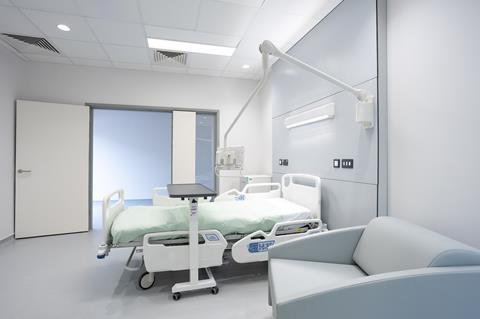
The UK’s new hospital programme (NHP) is often discussed in terms of its sheer scale: the billions of pounds committed; the size of the projects; the number of people the new hospitals will benefit; and the value to the construction industry of the contracts.

So, one of the programme’s most consequential steps forward could easily be overlooked: a single, full‑scale inpatient bedroom prototype now undergoing testing. The model room, complete with ensuite and corridor, is so significant because it is designed to prove that a standard, repeatable solution can be industrialised at programme scale, cutting risk and accelerating delivery of the next generation of NHS hospitals.
Why does this matter? The NHP will deliver state‑of‑the‑art hospitals through successive five‑year waves, backed by an initial £15bn, averaging £3bn per year. Early schemes between 2025 and 2030 will prioritise hospitals affected by RAAC to safeguard patients and staff.
This is one of the largest and most ambitious infrastructure undertakings in the country, and it depends on a platform approach the NHS calls Hospital 2.0, which puts modern methods of construction (MMC) and industrialised construction front and centre.
Seen through this lens, the bedroom prototype is the first step on the path towards a standardised solution for Hospital 2.0 set up for mass production. Built through industrialised construction at Reds10’s off‑site facilities in Driffield, East Yorkshire, the prototype exists to get things right first time: to verify room and corridor spatial requirements, iron out MEP interfaces, and run realistic scenarios before designs are locked and replicated thousands of times (the bedroom alone will be replicated over 3,000 times in just the first wave of hospitals).
We have rebuilt some parts of the prototype five times in response to feedback to ensure each element is absolutely optimised from a clinical perspective
NHP clinical teams and a wide range of stakeholders, including public and patient voice forums, have been reviewing and testing the prototype, validating observation from corridor to bedside, patient transfer from trolley to bed, assisted movement into the bathroom pod, bed manoeuvrability, response to emergencies such as crash calls, and recovery from falls. They have stress‑tested service accessibility in ceilings and pods, connection details at the corridor‑to‑bedroom interface, and the practicality of equipping choices, lighting, window types, and door swings.
The rigorous process of testing and extensive programme of stakeholder engagement has led to multiple improvements to the original designs aimed at ironing out deficiencies identified through clinical feedback. We have rebuilt some parts of the prototype five times in response to feedback to ensure each element is absolutely optimised from a clinical perspective.
The prototype is still a work in progress and is now undergoing the next level of technical design, including highly detailed specifications, such as the type of hinges, and the best position for medical gases.
The testing regime speaks to why standardised prototypes matter: because every improvement is bedded into the programme, rather than a one-off. Ultimately, if approved by the NHP, the prototype becomes the standard inpatient bedroom across the Hospital 2.0 programme and the upfront rigour in optimising the prototype will avoid the late‑stage rework that has plagued complex healthcare builds. It means that any technical issues can be resolved now, before 11 new hospitals are built simultaneously.
At the IHEEM Healthcare Estates Conference in October, where the full-scale prototype was showcased, Reds10 and the NHP were able to explain design decisions from a clinical perspective, demonstrating how highly specific clinical requirements, the rigorous testing, and extensive stakeholder engagement had directly shaped the designs. During the two-day event, we welcomed a staggering 352 visitors and completed 36 guided tours of the prototype, sparking valuable conversations about the future of healthcare infrastructure. For many attendees, it was a penny-drop moment.
For the construction industry, the implications are certainly profound. When main contractors are appointed to wave 1 and 2 of NHP, they will be provided with a fully specified design for the in-patient bedroom, reducing risk, waste and programme cost.
The industrialised construction process will drive up productivity, quality and sustainability, all the while delivering better value
The prototype has been developed to enable true design for manufacture and assembly (DfMA) and industrialised construction processes. This ensures sub-assemblies can be made by different UK manufacturers to build elements of the in-patient bedroom, such as bathroom pods, IPS panels, bed heads, door sets, vertical and horizontal riser sets, and external 2D wall panels.
This creates a more attractive market for suppliers by stabilising requirements and signalling a pipeline where investment will pay back, giving manufacturers confidence to invest in people, automation and quality systems because the rules, interfaces and volumes are finally predictable. That is exactly the environment which the government wants to foster with Hospital 2.0’s programmatic approach.
Industrialising Hospital 2.0 starts with an inpatient bedroom that works for clinicians, patients and maintainers, every time, at scale. The industrialised construction process will drive up productivity, quality and sustainability, all the while delivering better value.
The bedroom prototype shows that the NHS and its supply chain are finally building that system, not just the next project and in the process transforming the construction of hospitals for decades to come.
Bluebeam has announced a series of product updates aimed at improving connectivity between office and field teams across construction projects. The release includes the launch of Task Link, a native integration between Bluebeam Revu and GoCanvas, alongside enhancements to Bluebeam’s iOS and Android applications.
The updates are designed to reduce workflow fragmentation by improving task handoffs, increasing real-time visibility, and centralising project documentation. Bluebeam is part of the Nemetschek Group and develops collaboration and productivity software for architecture, engineering and construction professionals.
Task Link represents the first major product integration following the combination of Bluebeam and GoCanvas. The functionality enables tasks created in Bluebeam Revu to be pushed directly to the field, where progress updates are reflected in real time. Field teams can submit structured data through GoCanvas mobile forms, including photographs, videos and signatures, with all information automatically linked back to the original Revu markups.
According to Bluebeam, the integration is intended to close the gap between planning and execution by providing a single, traceable workflow across office and site teams. Automatic notifications keep stakeholders aligned as tasks progress, while centralised documentation supports accountability and reduces the risk of errors.
Luke Prescott, Head of Product at Bluebeam, said the release marked an important step in improving interoperability between office-based design coordination and on-site execution, enabling faster and more collaborative working practices.
Task Link is available to Bluebeam subscribers who also hold an active GoCanvas subscription.
In parallel, Bluebeam has introduced a range of mobile enhancements focused on improving field usability. The updates strengthen integration with Bluebeam Studio and expand core markup and collaboration tools on mobile devices. These improvements are intended to allow teams to verify, annotate and share information in real time, whether working online or offline, helping to improve decision-making and reduce rework during construction delivery.
East West Rail has set out the next phase of its Oxford–Cambridge scheme, outlining plans for more frequent services, new stations and wider upgrades intended to support long-term economic growth across the corridor.
The East West Railway Company (EWR Co) confirmed on 19 November that it is progressing plans for the second phase of the multi-billion-pound project, which aims to improve east–west connectivity between Oxford and Cambridge. The scheme is a central element of the government’s Plan for Change and is expected to unlock £6.7 billion in regional economic growth by 2050, enable up to 100,000 new homes and support tens of thousands of jobs.
Following consultation with local communities, EWR Co said it is exploring an increase in train frequencies from three or four services per hour to up to five. The change could deliver up to 70 per cent more seating capacity, reduce waiting times and improve reliability across the route.
The proposals also include new station entrances at Bletchley, Cambridge and Bedford, alongside four new stations on the Marston Vale Line. This would mark the first major investment on the line since the 1960s and is intended to address low current usage by offering faster and more frequent services.
A new station at Stewartby has been confirmed to serve local growth and provide access to the proposed Universal theme park in Bedfordshire. The attraction is expected to contribute almost £50 billion to the economy by 2055 and attract more than 8.5 million visitors in its first year.
Further plans include a total of seven new stations and the introduction of hybrid battery-electric trains to operate on partially electrified sections of the route. In Cambridge, proposals cover a new eastern entrance at Cambridge Central and a new Cambridge East station, with improved links via the upgraded Newmarket Line to Norwich, Felixstowe and Ipswich.
Transport Secretary Heidi Alexander said:
East West Rail is more than a railway – it’s a catalyst for growth, more jobs and opportunity, and this project will make rail travel faster, greener and more reliable for millions of passengers.
By investing in modern infrastructure, we’re laying the foundations for long-term prosperity in one of the UK’s most dynamic regions while ensuring that the UK has a rail network passengers can be proud of.
David Hughes, CEO, East West Railway Company, said:
These updates reflect our commitment to listening to communities while designing a railway that delivers long-term benefits for the region. Our latest proposals better reflect what matters most to people and will deliver better outcomes for passengers, local communities and the environment.
From a new station at Cambridge East to better access in Oxford and clear alignment through Tempsford, East West Rail is shaping the modern, sustainable transport link this region needs to thrive.
NavLive, a UK-developed reality capture technology company, has secured £3.3m in seed funding to support the further development and commercialisation of its handheld scanning platform.
The company’s core product is a handheld LiDAR scanner that combines reality capture with edge-based artificial intelligence. Developed from robotics research at the University of Oxford, the system enables users to scan buildings and generate accurate site data in real time, including instant 2D and 3D building models, RICS-grade 1:100 surveys, and direct scan-to-BIM outputs.
NavLive’s technology has already been deployed on live projects by a number of major engineering and construction firms, including Jacobs, AtkinsRéalis and Mace.
The business currently employs a team of 15 people and operates from offices in London and Oxford. It is led by chief executive officer Chris Davison, an experienced entrepreneur with a background in finance. Chief technology officer Dr David Wisth holds a PhD in computer vision, simultaneous localisation and mapping (SLAM), and robotics, and specialises in 3D mapping and artificial intelligence.
The funding round was led by deep-tech investor OSE, with participation from SOSV, Oxford Capital Partners, Clearance Venture Partners, AE Works, Britbots, and Oxford Innovation Finance. In addition to the equity investment, NavLive secured a £700,000 grant from Innovate UK last year.
The company said the funding will be used to scale its team, accelerate product development, and expand adoption of its technology across the built environment sector.
This article first appeared in Building Design. Read the full article here.
Martyn Evans argues that one of Britain’s largest and most vital industries remains hidden in plain sight. He urges the government and business to recognise the built environment as a unified sector central to national prosperity

There is a vast, world-shaping industry in Britain that we scarcely recognise as an industry at all. It employs nearly four million people, contributes almost a quarter of national output, and touches every aspect of our daily lives, from where we live and work to how we travel and learn. And yet, when policymakers in Westminster talk about “key growth sectors”, it rarely even makes the list.
This is the built environment, the ecosystem of professions, trades, technologies and services that together design, construct, manage and sustain the places we inhabit.
A recently published report, The Built Environment Sector, from New London Architecture (NLA), produced with GLA Economics, LSE and Polygon Place Strategy, exposes just how extraordinary this hidden powerhouse really is. Taken together, the professions and services that make up the built environment contribute around £568bn to the UK economy every year, a staggering 24% of national GVA, and account for roughly 3.8 million jobs, or 12% of the total workforce.
To put that in perspective, the built environment is twice the size of financial services and four times larger than the creative industries.
Without a coherent identity, the built environment has no single voice in government, no integrated policy framework, and no clear channel for investment or innovation
And yet, despite this scale, the sector is treated almost as an administrative afterthought. It is split across government departments, fragmented in statistics, and invisible in industrial strategy.
Architecture is filed under “creative industries”, construction under “infrastructure”, engineering under “manufacturing”, and property under “real estate and finance”.
But, when you step back, it is clear that all of these activities are part of one continuous chain, from conception to completion to operation, united by a single purpose: shaping the physical fabric of the nation.
This fragmentation has consequences. Without a coherent identity, the built environment has no single voice in government, no integrated policy framework, and no clear channel for investment or innovation. Decisions which affect its future – on planning, housing, skills, sustainability, procurement and taxation – are made in silos.

The result is duplication, inefficiency and missed opportunity. We talk endlessly about productivity and growth, yet one of our most productive and employment-rich industries is hiding in plain sight, under-recognised and under-supported.
Imagine if the financial sector were treated in this way, its components scattered between departments, its data buried in the footnotes of government reports. It would never have achieved the global dominance it enjoys today. In fact, the financial services sector only became politically powerful once it was recognised as a single entity.
Before the “big bang” reforms of the 1980s, banking, insurance, accountancy and legal services were regarded as separate professional domains. By bringing them under one umbrella, the City created a collective identity that commanded strategic attention and tailored policy. The built environment deserves the same clarity of definition and the same level of government focus.
The potential gains are enormous. A unified built environment sector could drive innovation, investment and exports at a scale that rivals Britain’s other leading industries. Our architects and engineers already win work across the world, yet we rarely brand or promote them as part of a coherent national industry.
Our construction and real estate companies are pioneering low-carbon materials, off-site manufacturing and digital design, but they operate within fragmented regulatory regimes. Our facilities managers and retrofit specialists are critical to achieving net zero, yet they are seldom included in industrial strategy. If government recognised this as one interconnected ecosystem, it could design policies that amplify rather than dilute the power of its constituent parts.
A coherent industry identity would also transform how we develop and retain talent
At a time when the UK faces a daunting list of structural challenges, from housing shortages and crumbling infrastructure to the climate crisis and regional inequality, the built environment is central to every solution. We cannot build greener, fairer, more prosperous communities without harnessing the collective capability of those who design, construct and manage them. But this will only happen if we treat the built environment not as a cost to be controlled, but as an engine of growth to be cultivated.
A coherent industry identity would also transform how we develop and retain talent. With almost four million people employed across the value chain, the built environment offers routes into skilled and secure work for every level of education and experience.
But the current fragmentation means there is no unified skills framework, no clear career pathways between related disciplines, and no central coordination of training or apprenticeships. Recognising the built environment as a single industry would make it possible to plan a national workforce strategy, one that connects trades and professions, strengthens regional economies, and provides mobility across disciplines as technologies evolve.
Then there is the question of innovation. A single, recognised built environment sector could qualify for targeted R&D funding, challenge-led investment and cross-sector innovation programmes.
It could pool research in areas such as decarbonisation, modular construction, digital twins and circular materials, all vital to the UK’s competitiveness in a global market that is rapidly transitioning to sustainable, tech-enabled infrastructure. The current piecemeal approach, with each sub-sector chasing its own limited pot of grants, is not fit for purpose.
Critics might say the built environment is too broad and diverse to be treated as a single sector. After all, what do an architect and a brick manufacturer really have in common? The answer is: more than enough. Other major industries encompass wide variation, think of how “life sciences” unites pharmaceutical companies, biotech start-ups and hospital suppliers under one strategic umbrella.
This is not a plea for special treatment, but for accurate recognition
The point is not to erase differences, but to create a shared framework for coordination, investment and policy. A unified built environment industry would still contain distinct professions and specialisms, but it would operate with a collective sense of purpose.
Equally, some will worry about adding another layer of bureaucracy. But the current system is already bureaucratic, only in a disjointed, inefficient way.
Planning policy, infrastructure investment, housing delivery, energy retrofits and skills training are managed by different departments with overlapping responsibilities and conflicting priorities. A single ministerial office or cross-departmental taskforce for the built environment could streamline rather than complicate government decision-making, providing clarity of accountability and purpose.
The NLA report is a wake-up call to policymakers. It gives us, for the first time, a rigorous evidence base to quantify the built environment’s economic weight.
It shows that what we have long treated as a background activity, the stuff that happens after the “real” industries have done their work, is in fact one of Britain’s most vital engines of prosperity. The report calls for nothing less than a “Big Bang” moment for the built environment, a collective recognition by government, business and the professions that they are all part of one industry, and that only by working together will they realise their full potential.
This is not a plea for special treatment, but for accurate recognition. The built environment is not an appendage to other sectors; it is the stage upon which all others perform.
Every factory, school, hospital, home and office exists because of it. Every goal we have for growth, productivity and sustainability depends on it. The government cannot afford to keep treating this sprawling ecosystem as a set of disconnected fragments.
It is time to name it, unify it and elevate it, because the built environment is not just where we live and work. It is one of the most important industries we have.
His Majesty’s Prison and Probation Service (HMPPS) has reported constructive losses of £23.99m linked to the prison capacity programme, according to newly released figures.
The losses stem from construction costs written off on projects that have since been descoped, alongside costs associated with supplier failure. HMPPS stated that the programme is subject to continuous evaluation to ensure that investment is directed towards schemes offering the strongest value for money and the greatest feasibility in delivering the government’s commitment to 20,000 additional prison places by 2031.
Several projects were halted after significant increases in expected completion costs, attributed in part to extensive asbestos contamination. As a result, HMPPS concluded that continuing with these builds would no longer represent value for money.
The organisation has indicated that further losses of a similar scale are expected to be reported in its 2025–2026 annual accounts, relating to construction, demobilisation and remediation costs incurred after March 2025.
This first appeared in PBC Today. Read the full story here.
In recent years, the delivery of major infrastructure projects has been plagued by spiralling costs, stop-start decision making and public apathy. Sam Gould, director of policy and external affairs at the Institution of Civil Engineers, examines what needs to change

For many years, infrastructure supply chains and investors have asked for a stable, long-term plan for delivery from government. This year, the UK government answered that call with an ambitious 10-year Infrastructure Strategy, a Modern Industrial Strategy and a new online pipeline tool.
These publications mark a shift in this Parliament from planning to delivery. The pressure is now on to demonstrate progress by the next election (expected in 2029). The success of the aforementioned strategies will depend on the capacity of the infrastructure ecosystem to respond.
Overcoming barriers to infrastructure delivery
The 10-year strategy outlines a huge increase in new infrastructure over the next decade. The scale isn’t fully understood yet and there’s a lingering concern that the government may have underestimated the barriers the supply chain faces.
The Institution of Civil Engineers is exploring what those barriers are – and the policy options that could help overcome them.
Our recent paper, Why Do Major Projects Take So Long and Cost So Much?, examined how projects can be delivered faster, for less money. Its recommendations included aggregating assurance evaluation data, establishing a roving delivery unit in government to support public bodies, and more meaningful engagement with the public about infrastructure projects.
We’re also looking at what needs to happen in the wider infrastructure ecosystem. Confidence among investors and companies in the supply chain remains low after decades of uncertainty arising from delayed decisions, stop-start funding and cancelled projects.
Challenges include vulnerable domestic and global supply chains, skills gaps, planning delays and wary investors.
We recently hosted a panel event with infrastructure leaders to explore these topics and several themes emerged from the discussion:
- The importance of collaboration and strategic relationships.
- The need to boost productivity as well as growing the workforce.
- How rationalising – rather than merely speeding up – planning can achieve better outcomes.
- Why making the most of the infrastructure we already have should be a much greater priority.
Collaboration is key
First, collaboration. The 10-year strategy and the increased volume of work should encourage more long-term strategic relationships between contractors and suppliers and the use of enterprise-based models, like Project 13.
These approaches could reduce costs associated with one-off purchases and annual bidding processes and inefficiencies arising from the UK’s fragmented construction sector.
We’ve heard about positive examples of this already. In the energy sector, the Great Grid Upgrade is benefiting from the alignment between the government, the regulator and network companies.
Collaboration should extend to how risk is shared between the public and private sector. The Thames Tideway sewer project showed how transparent and appropriate risk sharing between government and the private sector can lower costs – for project delivery and ultimately on customer bills.
Closing the skills gap
Second, skills and productivity. While the government has promised more investment to increase the workforce, it’s unlikely to be enough to meet expected demand in construction and engineering. The UK also faces a shortage of leaders capable of overseeing the many complex major projects and programmes ahead.
More early careers engagement to inspire young people can help close skills gaps in the longer-term. In the shorter-term, reconsidering immigration restrictions may be one option.
But the UK won’t be able to deliver on its infrastructure ambitions without a much bigger focus on improving productivity and innovation in the supply chain, for example through more offsite construction.
Rationalising the planning system
Third, planning. There’s been much talk about speeding up planning decisions through the government’s Planning & Infrastructure Bill. However, it’s still unclear how effective
the legislation will be and concerns remain about potential compromises to environmental protections.A greater focus on rationalising the system, ensuring it is well-coordinated and properly resourced, will also help deliver better outcomes. For example, the Infrastructure Client Group is exploring how better data sharing, integration and collaboration can enable solutions to be repeated across programmes.
More early and meaningful engagement with the public, emphasising a clear narrative and the whole-life benefits of infrastructure projects – like social mobility and economic
growth – can build support, reduce delays and lower costs.Finally, we shouldn’t overlook that the UK already has most of the infrastructure it will use in the coming decades. But historically, government and industry have been poor at considering the upsides of investing in that infrastructure – and the downsides of not doing so.
Maintaining and upgrading those assets is increasingly urgent in the face of climate change and other risks. Properly maintaining existing assets will lessen the need for new infrastructure.
In our panel discussion, it was noted that Private Finance Initiatives used to incentivise infrastructure owners and operators to take a whole-of-life approach to their assets. That type of long-term thinking needs to be at forefront of decision-making as we embark on delivering a new infrastructure strategy.
We’re keen to hear further views on these topics. To share your views please contact us at policy@ice.org.uk.
The government has confirmed that Heathrow Airport Limited’s (HAL) third runway proposal will form the basis of the forthcoming review of the Airports National Policy Statement (ANPS), advancing plans for a major expansion of the UK’s largest aviation hub.
Transport Secretary Heidi Alexander announced on 25 November that HAL’s scheme had been assessed as the most deliverable option among the remaining proposals, offering the strongest likelihood of enabling a development consent decision within the current parliamentary term. A revised ANPS is expected to be consulted on next summer, with a final planning decision anticipated by 2029. If approved, a new runway could be operational by 2035.
The review will evaluate how the expansion aligns with the UK’s legal obligations on climate change, air quality and noise. The government has requested advice from the Climate Change Committee to ensure that updated policy reflects the aviation sector’s contribution to national carbon budgets. Officials emphasised that selecting HAL’s scheme at this stage does not constitute final approval for the runway’s design, length or associated infrastructure, which will continue to be examined.
Heathrow, the UK’s only hub airport, recorded 23.4 million passengers this summer, underlining rising demand for capacity. Ministers argue that expansion would strengthen international connectivity, attract investment and support economic growth.
The announcement accompanies wider efforts to modernise UK airspace. Newly published strategic objectives will prioritise redesigning the Greater London airspace block, with the aim of enabling quicker, quieter and more efficient flight paths ahead of the projected 2035 runway opening. A consultation has also opened on simplifying Air Navigation Guidance to streamline decision-making and reduce emissions.
The milestone follows recent approvals for expansion projects at Luton and Gatwick airports. The government is also advancing its Sustainable Aviation Fuel Bill and investing £63 million to accelerate domestic SAF production, with an annual progress report to be published jointly.
Transport Secretary, Heidi Alexander said: “Heathrow is our only hub airport which supports trade, tourism and hundreds of thousands of jobs, underpinning prosperity not only in the South East but across the UK.
“Today is another important step to enable a third runway and build on these benefits, setting the direction for the remainder of our work to get the policy framework in place for airport expansion. This will allow a decision on a third runway plan this parliament which meets our key tests including on the environment and economic growth.
“We’re acting swiftly and decisively to get this project off the ground so we can realise its transformational potential for passengers, businesses, and our economy sooner.”


Industrialised Construction Media Ltd
Suite E Hermes House,
Oxon Business Park,
Shrewsbury,
SY3 5HJ
© 2026 Industrialised Construction Media Ltd. All rights reserved. Registered in England and Wales #16508299. Registered address: Hermes House, Oxon Business Park, Shrewsbury, SY3 5HJ